Zoos Victoria digital design and campaigns
At Zoos Victoria, I spent 8 years producing content for major visitor events and programs (like visitation-driving school holidays campaigns), fundraising and behaviour-change campaigns, including Don't Palm Us Off, They're Calling on You, Wipe for Wildlife and Beads for Wildlife, as well as threatened species programs and on-site exhibits and information screens.
You can see some of my Zoos Victoria photography and video on a separate page >>
Zoos Victoria community conservation behaviour change campaigns
Zoos Victoria wanted to change from being a more traditional zoo, a passive place that people went to just look at animals, to being a place that helps to drive wildlife conservation and helps to stop animals from going extinct, “fighting extinction”, a “zoo-based conservation organisation” (ZBCO). I was lucky enough to be at Zoos Victoria as “Website Manager” (in practice, it was partly a digital campaigns and experience manager role) when they had just decided to undertake a major change in direction in 2008 and to start community conservation campaigns using the CUA model.
The Connect-Understand-Act (CUA) model is a behaviour change framework developed by Zoos Victoria and pushed by Wildlife Conservation and Science Director Rachel Lowry. It is designed to replace traditional "education-only" methods by engaging audiences on environmental issues through a three-step progression that builds empathy, provides knowledge, and removes barriers to practical conservation actions.
The CUA model is broken down into the following specific phases:
Connect focuses on targeting empathy, love, and compassion to shape positive attitudes toward wildlife. It helps individuals develop a personal connection and sense of pride in protecting specific species or environments.
Understand: Moves beyond emotional connection to teach the priority ecological understandings. This ensures people understand the threats to wildlife, why the animal is important, and how the environmental issue directly impacts them.
Act: Translates empathy and knowledge into a tangible, measurable conservation action. This phase focuses heavily on removing barriers to target behaviours, teaching the necessary skills, and providing the community with actionable steps to live in balance with wildlife.
Zoos Victoria uses this model to run award-winning, measurable community campaigns (such as Wipe for Wildlife, When Balloons Fly Seabirds Die, Beads for Wildlife, There's Calling On You and Don't Palm Us Off) by targeting community-driven threats with a clear, facilitated call to action.
I worked on these programs for 8 years, including helping develop the brief outlining how we would execute them on the website/digitally. I would also develop web pages and create assets such as videos, photos, graphics, and interactive content. I would also bug-test, work extensively with, and manage external agencies to create things like the Online Zooernarket for DPUO.
I worked extensively with the ZV wildlife conservation and science team, zoo educators, zoo exhibit coordinators at 3 zoos, different animal teams, external agencies and contractors. You can see some of the graphics I made below.
I also worked on Threatened Species programs, with the ZV wildlife conservation and science team, various animal teams, external researchers, Taronga Zoo, Victorian and New South Wales state government environmental departments, and national Park teams.
You can see my zoo photography and video work on a different slide >>
Find out more about the CUA Model here >>
Campaigns, behaviour change and growth
Across eight years at Zoos Victoria, my role went well beyond website management. I helped plan and deliver major visitor, school holiday, membership, fundraising and community conservation campaigns across Melbourne Zoo, Healesville Sanctuary and Werribee Open Range Zoo. My work included campaign planning, web and email content, social media assets, photography, video, animation, digital design, agency coordination, testing and post-campaign reporting.
I worked closely with Zoos Victoria's Wildlife Conservation and Science team on behaviour-change campaigns using its Connect–Understand–Act approach. These included Don't Palm Us Off, They're Calling On You, Wipe for Wildlife, Beads for Wildlife and Love Your Locals. I helped turn conservation objectives into digital content and practical actions people could take. The Don't Palm Us Off online petition attracted more than 58,000 signatures, while for Beads for Wildlife I helped establish two online shops and produced campaign web, visual and video content supporting conservation and communities in northern Kenya.
I also worked on the organisation's commercial and visitor side. We reduced the online membership process from 22 steps to five, helping increase online membership revenue by 50%, and an A/B test of Melbourne Zoo's Get Close to Wonder landing page increased online ticket sales by 23%. Over my eight years at Zoos Victoria, annual website visitation grew from 0.8 million to 3.4 million.
Looking after the digital branding, email templates, digital design and membership.
"Just in time for school holidays, a new reason to visit!" - our often-used tagline.
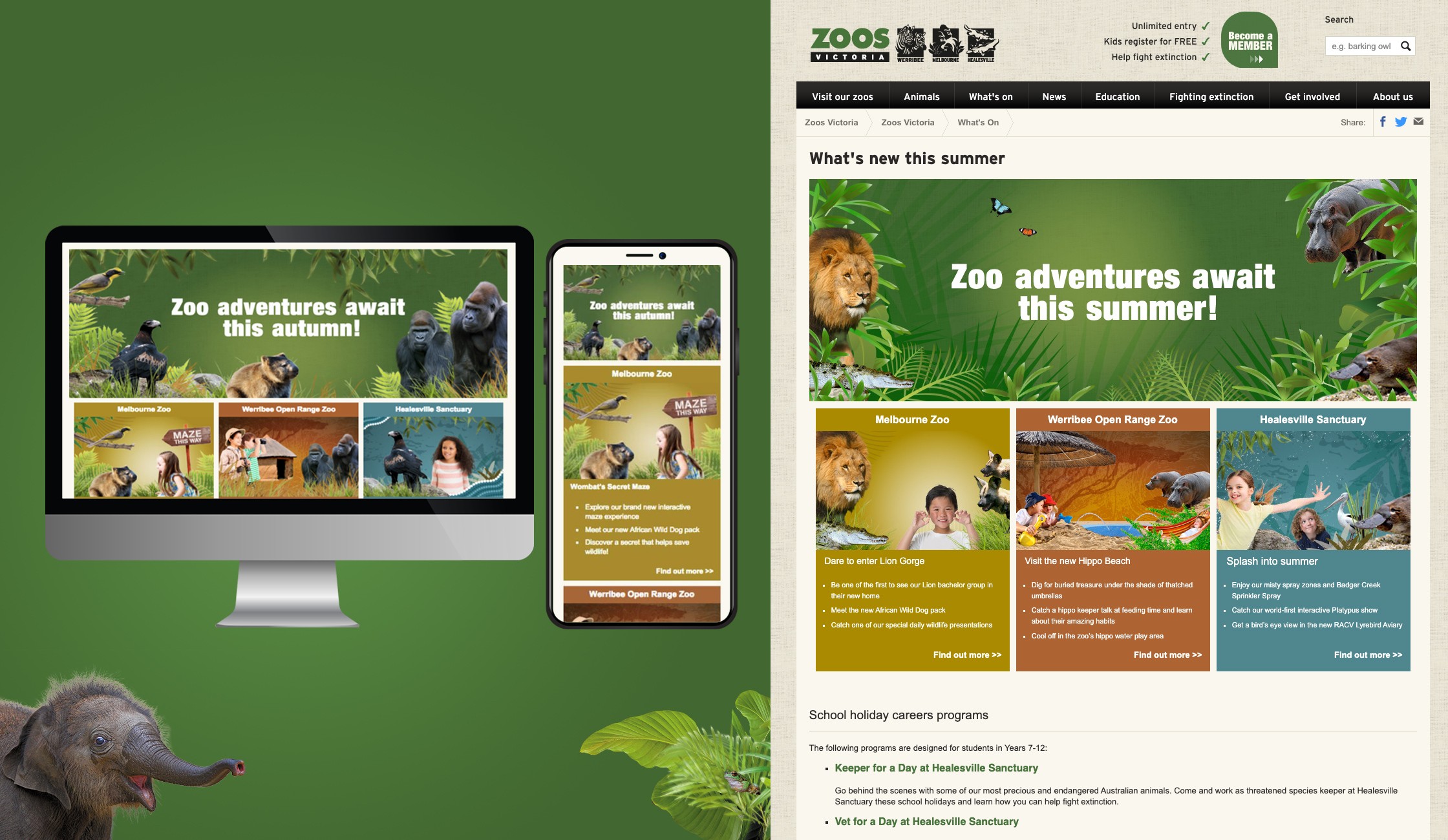
For the first two years (of my Zoo life), the school holiday quarterly landing page featured the old branding. I experimented with adding more photos and reducing the amount of text in web pages. See the holiday page from February 2011 >>.
My role was to create refreshed event pages every quarter from 2009 to 2016. The website needed to align with the print and/or TV advertising campaigns.
This is what I created :
One main Zoos Victoria landing page design (words/copy editing, digital graphics, custom HTML/CSS, device testing and bug fixing) for desktop and m-site for mobile.
Three event pages for free programs (graphics and build). One event page for each Zoo.
Three event pages featuring paid careers or childcare programs (graphics and build). One event page for each Zoo.
Four homepage banner designs for Zoos Victoria and the three Zoos.
Social media and email graphics and occasional social media and/or website competitions (including naming competitions).
Designs that align/match the Zoos digital visual style guide.
End-of-program reporting and analysis after the quarter ends.
Each campaign became an opportunity to refine how the Zoos Victoria brand was presented online, evolving the design with larger banners, richer colours, and creating a more engaging, visually cohesive experience.
See What’s new this Autumn in 2015 >>
In the Summer of 2017, we transitioned away from the highly successful quarterly school holiday programs. At Melbourne Zoo, we ran “Get Close to Wonder“, a summer A/B test of a new responsive, video-enhanced, event-focused template. This led to the development of a new, event-focused responsive homepage design for all three Zoos. I was involved in leading all these projects.
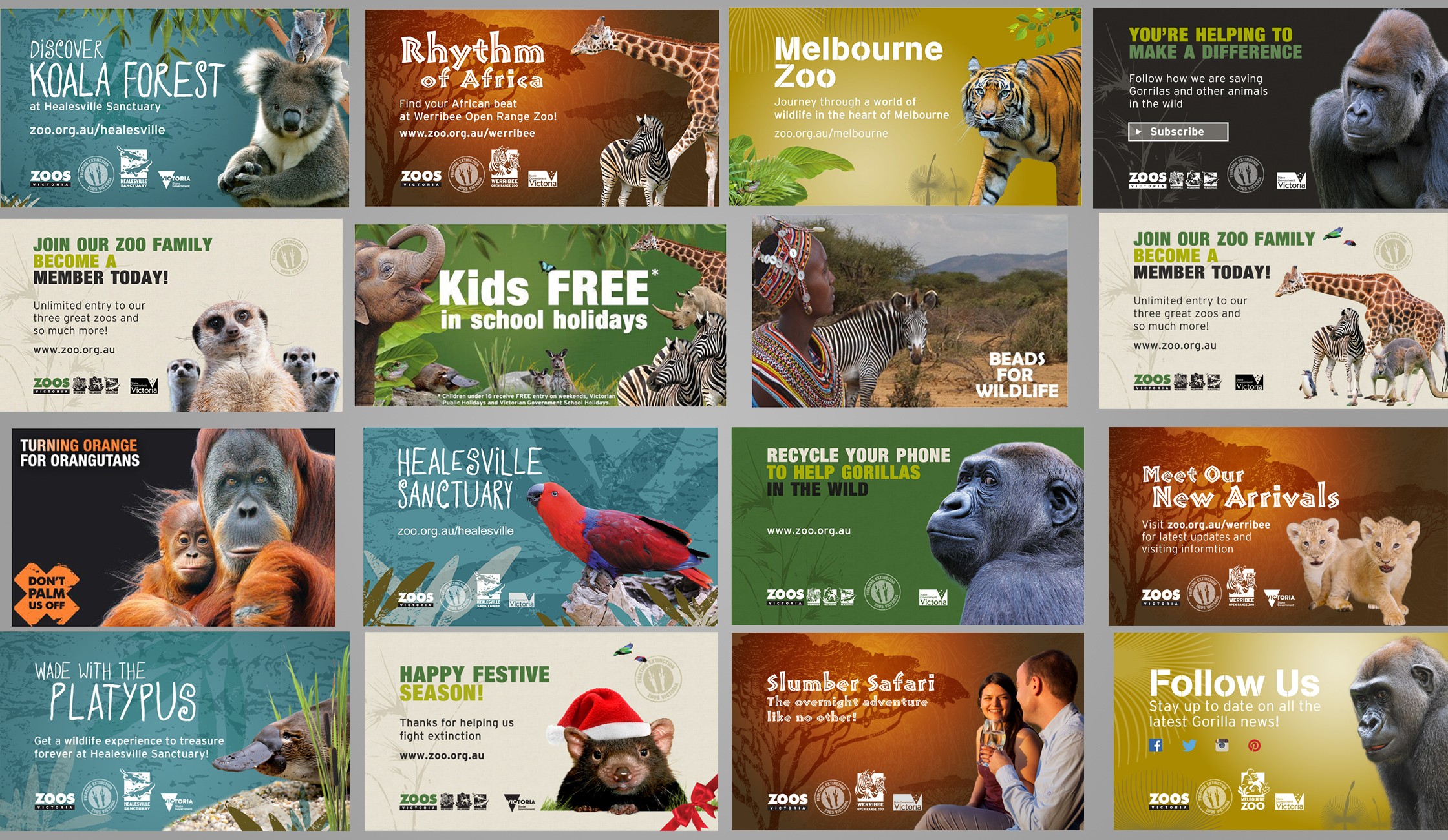
Creating banners for different projects (Conservation, Videos, Membership, Events and Exhibits) below.
Note, they are slightly different sizes.
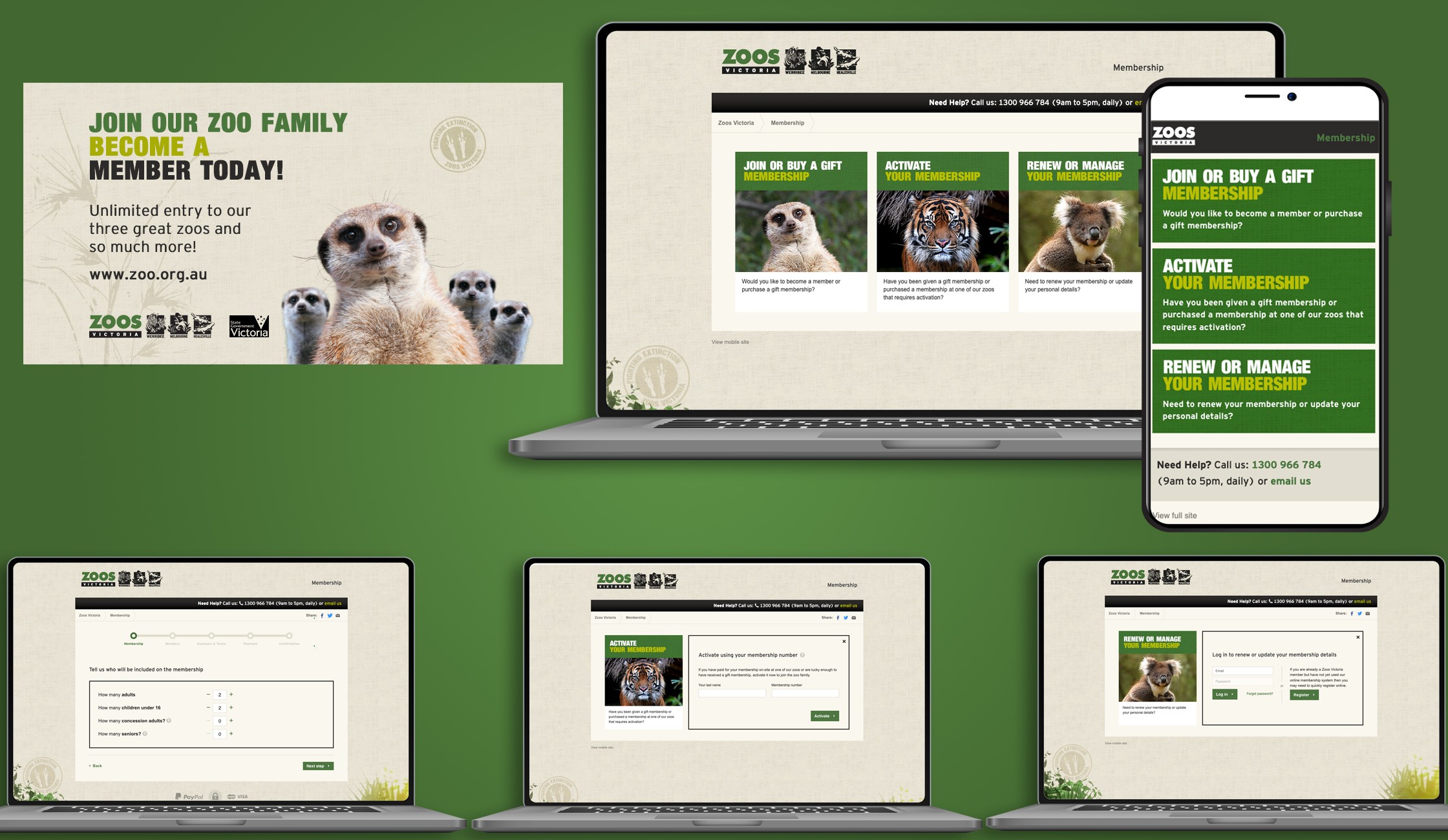
Building a new Zoo Membership System
The Zoo's previous online membership system was very confusing, requiring an overwhelming 22 steps to join. Working with digital agency Monkii (now Calico), we created a simpler membership process that cut the steps to just 5, including options for Pay-by-the-month and PayPal. The new system was designed to connect smoothly with our existing on-site systems, be mobile-friendly, and stay operational even during maintenance. This resulted in a 50% boost in online revenue thanks to the more user-friendly experience built on Drupal Commerce.
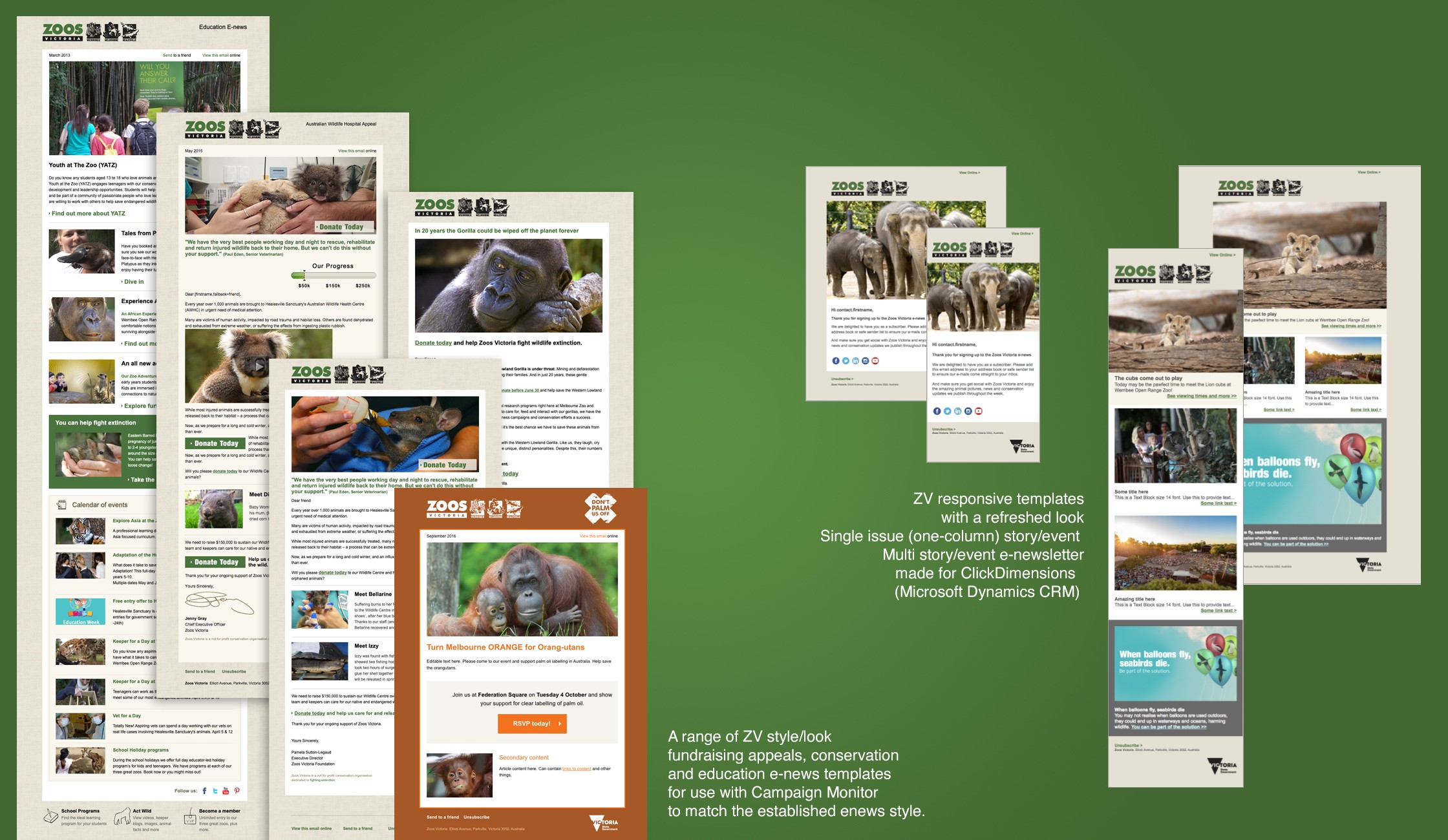
Building on a strong band with a new refreshed look
Looking after the digital design for Zoos Victoria's website and email templates